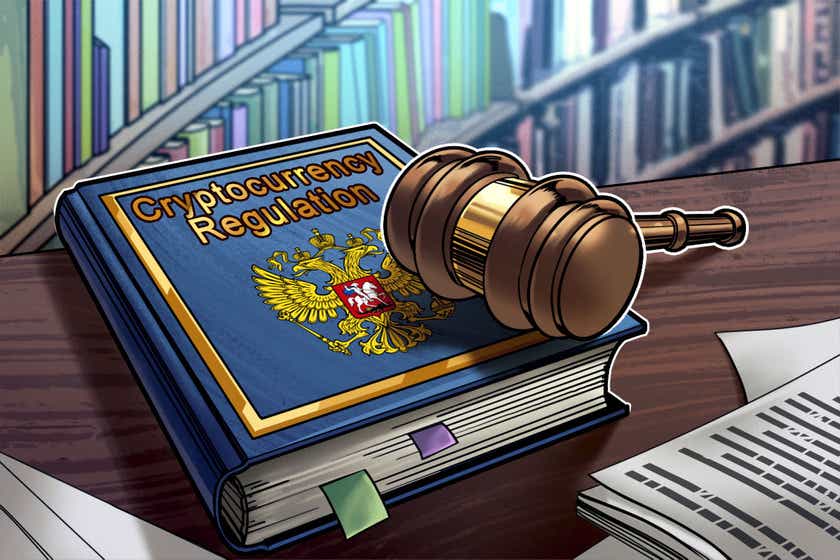



Policymakers in Moscow are scrambling to rethink their approach to digital currency as one of several means of protecting the increasingly isolated economy.
In January 2022, the Central Bank of Russia (CBR) proposed a number of measures aimed at curtailing the country’s cryptocurrency market, which included a blanket ban on the use and mining of all cryptocurrencies. It pointed out risks posed by the volatile nature of cryptocurrencies to the financial stability of the country, the extensive use of crypto in illegal activity and the energy costs involved in crypto mining. However, the utility of blockchain technology didn’t escape the CBR. The following month, it announced that it had started the pilot stage of the digital ruble, its planned central bank digital currency (CBDC).
Following the Russian legislature’s decision to recognize the Ukrainian separatist states of Lugansk and Donetsk, however, the majority of Russian Duma MPs were slapped with financial sanctions by the European Union. In early March, in response to the events in Ukraine, the CBR was also hit with sanctions. It became apparent that further sanctions by the EU, United States and other Organisation for Economic Co-operation and Development (OECD) nations were likely to arise.
Sanctions-induced pivot
When formerly legal financial transactions with the West were criminalized, speculations as to the future of cryptocurrency in Russia abounded. According to Stanislav Tkachenko, a professor of international affairs and economics at St. Petersburg State University who has written extensively about monetary regulation, there had already been interest among policymakers in the future promotion of both the CBDC and existing cryptocurrencies.
Tkachenko pointed out that Russia was looking at how China was approaching the introduction of a state digital currency and believed that Russia would simply copy what China was doing. He noted that the Russian switch to partnering with China in bilateral trade would probably lead to higher transaction costs, as the commodities Russia sells are most commonly priced in dollars in international markets, and China prefers the exclusive use of renminbi for its own market. Traditional transactions would have to take place in rubles, dollars and Chinese yuan.
Tkachenko was optimistic about the prospects for cryptocurrency mining in the immediate future, as global sentiment toward Russian energy has soured, resulting in both sanctions and proposed additional sanctions. These, he explained, were driving global energy prices up but also left Russian energy producers without a global market to cater to. This could lead to both a more lenient attitude toward crypto mining within Russia and further attempts to restrict Russian access to the cryptocurrency market abroad.
CBDC problems
Any central bank digital currency has several major drawbacks, and a few more can be added in Russia’s case. First, the utility of anonymous transactions is lost. While the potential use of anonymous transactions for money laundering and the financing of terrorism has worried CBR regulators for decades, a CBDC would inevitably be targeted.
In the U.S. and the EU, operations carried out by six major Russian banks have been blocked: VTB, Novikombank, Sovcombank, Otkritie, PSB and Bank Rossiya. It is now impossible to transfer dollars and euros from their accounts to any country in the world, and the Visa and Mastercard cards issued by any Russian bank do not work abroad. However, the elimination of dealings with Russian banks hurts existing foreign business, which is something that couldn’t be said for a new state-issued cryptocurrency.
Another is that the Russian “brand” has fallen in value elsewhere in the world, with crypto exchanges being compelled to shut down coin wallets held by Russian individuals. While regulators have long feared that Bitcoin (BTC) would be used to pay for illegal darknet transactions, the association of the CBDC with Russia would render all usage suspect.
In 2017, President Nicolas Maduro announced the creation of the state-backed petro cryptocurrency in sanctioned-hit Venezuela, hoping to boost the nation’s spiraling economy. However, it has had little practical application: Venezuela used it in 2019 to make small payments to retirees and often uses it to price services or fines that are ultimately paid in the local currency. Cryptocurrency is usually thought of as both a speculative instrument and a medium of exchange. On these two fronts, the petro has fallen flat.
Digital assets’ wartime utility
One key utility of a potential CBDC is that it helps avert some of the vulnerabilities of the existing Russian banking framework in the context of wartime. If anything happens to Sberbank, VTB or any of the other banks, it would be difficult for Russians to transfer money via their respective banking apps, which are now used throughout Russia.
However, it can be expected that much of the world would scoff at a Russian CBDC, much as they scoffed at the release of the Venezuelan petro, given the government’s loan defaults and inability to access frozen assets abroad.
It would be downright foolish for Russia to limit itself to a CBDC without exploring crypto mining options. While the size of the Russian economy wouldn’t allow for mining to act as a stand-in for regular energy exports, the use of excess electricity for mining could help compensate for inaccessible foreign reserves.
The Russian government has the option of pursuing mining opportunities without outright liberalization. Blockchain mining could be done by state-run energy companies but banned among ordinary citizens, in much the same way that the Bahamas has gambling opportunities for foreign tourists, but Bahamian citizens are forbidden from taking part. This would have the added benefit of allowing electrical energy producers to balance cryptocurrency production with the use of the electrical grid by ordinary consumers.
However, such a practice could feed into growing concerns in the West that Russia could turn to crypto as a means of sidestepping punitive sanctions.
The eyes of Russia’s financial policymakers were on Beijing last month when it released the digital yuan, dubbed the e-CNY, for Olympians and visitors during the Winter Games. However, this was only the digital yuan’s international debut. There had already been more than a year of pilot runs in about a dozen regions of the country, involving more than 260 million people with e-CNY accounts by the end of 2021. Evidently, China’s CBDC is doing far better than Venezuela’s, as the volume of total digital transactions reached nearly 90 billion yuan, or $14 billion, according to the bank.
However, with the world’s second-largest economy, China has no problems generating such transaction volumes — it’s technically only $10 per person in what has already effectively become a cashless society. And, while China has faced trade restrictions, it has yet to be struck with any crippling sanctions like those facing Russia and Venezuela.
Pressure from the west
Last week, U.S. President Joe Biden signed an executive order that directs U.S. federal agencies to study and craft a comprehensive plan that would unify the government’s oversight of the cryptocurrency market. The very fact that U.S. financial regulators are seeking to limit Russia’s access to the world’s three trillion dollar cryptocurrency market may compel Russian lawmakers to do just the opposite.
The chief concern in the short term among policymakers, however, is for the health of the Russian financial system amid a shock decoupling from the West. Most of Russia’s $630 billion in foreign reserves, dubbed Putin’s “war chest” in the Western press, have been frozen, prompting fears of a default on Russia’s foreign-currency-denominated debt. As many surmise that the worst may be yet to come for the ruble, the CBR has been forced to introduce capital controls in order to prevent a general panic.
While Russia’s regulatory authorities may be interested in keeping money in the country, ultimately, they are also responsible for ensuring that international trade may continue despite the West’s traditional control of most of the world’s financial markets. As a result, they must both prevent immediate capital flight while facilitating Russia’s continued access to global markets. In order to prevent Moscow from relying nearly exclusively on Beijing for this access, it is highly likely that in the medium term, Russian regulators will act to facilitate access to cryptocurrency rather than eliminate it.