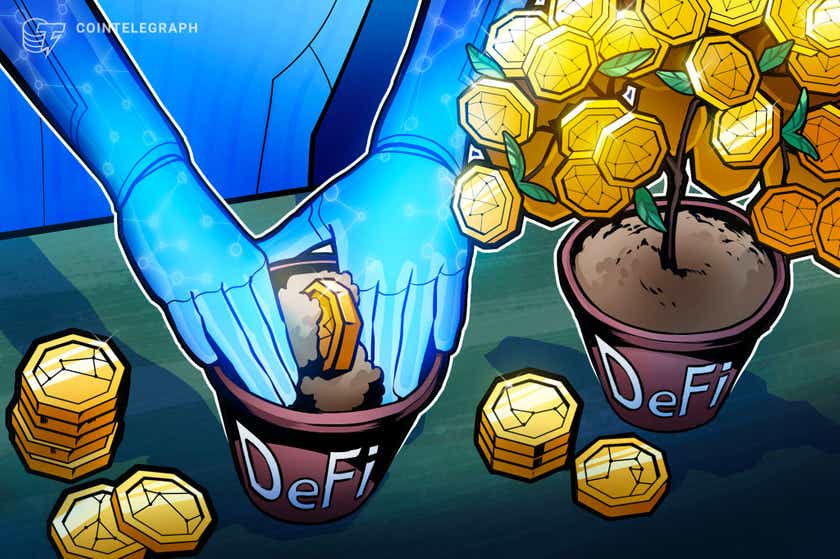

DeFi enables users to earn passive income without undergoing complex measures.
What platforms can I use in this case?
Modern tools can improve the earning process by diversifying asset exposure and empowering AI for quicker reaction times.
Although DeFi returns appear promising, investors must continue to air on the side of caution and remember even in DeFi, “get-rich-quick” schemes do not exist. Instead, a minimum level of awareness on topics such as how the blockchain works and what an automated market maker (AMMs) is are necessary for users to deploy passive income generation methods. Furthermore, early DeFi projects required users to be highly experienced while having adequate capital at their disposal.
SingularityDAO is one of the few platforms that generate yield by trading cryptocurrency assets through an AI-powered DeFi portfolio, giving users access to a diverse range of crypto tokens.
These tokens exist as DynaSets, which are sets of assets managed by a combination of professional traders and artificial intelligence. After assets are deposited in a DynaSet, users can allocate LP tokens representative of their share of a DynaSet. The Dynamic Asset Manager option will manage the assets, trading coins based on market info and trends, with the intent to generate yield.
The company claims DynaSets products’ performance exceeded the numbers of popular digital assets –– Bitcoin (BTC) by as much as 13.6% and Ethereum (ETH) by 18%.
Since smart contracts power Dynasets, users have the advantage of immediate reaction time and trade execution across multiple liquidity pools. The result is increased efficiency, fewer fees, and a slippage limit, all without creating an account.
Learn more about Singularity DAO
Disclaimer. Cointelegraph does not endorse any content or product on this page. While we aim at providing you with all important information that we could obtain, readers should do their own research before taking any actions related to the company and carry full responsibility for their decisions, nor can this article be considered as investment advice.
And what about lending?
In comparison, lending allows users to become a liquidity provider by depositing their funds into a lending or borrowing platform like Aave (AAVE). Another user can then borrow those funds at, say, a 9% interest rate. The lender is likely to earn 8% after fees are paid, a notable interest payment, especially when compared to traditional vehicles. The pay increase can be likened to the foundation for these protocols. Here, a decentralized exchange (DEX) will generate a liquidity pool containing a series of token pairs that anyone can pay liquidity into. Users are then issued LP tokens, each representing the user’s share in the pool. Tokens can later be redeemed alongside a share of the swap fees. APY’s are typically higher than other DeFi platforms, although they often hold slightly more risk since lending can be met with impermanent loss.
What are some of the methods to earn passively?
Within DeFi, yield farming, staking and lending have proved to be profitable methods for passive earning.
Several income generation methods have emerged since DeFi was born three years ago. Now, investors are likely to stumble across various decentralized protocols and other smart contract applications, each promising different reward opportunities. Among the most common passive income opportunities are yield farming (liquidity mining), staking and lending.
Yield farming or liquidity mining takes a user’s existing cryptocurrencies and invests them to earn more. The strategy requires investors to stake some of their holdings in a smart-contract-based liquidity pool, where funds will be redistributed through DeFi protocols to other projects. The fees required for use are passed forward to the user through rewards.
Perhaps the simplest to understand is that staking enables users to earn passive income by locking their tokens in a smart contract, allowing them to earn more of the same token.
At its core, the process is similar to a traditional bank, where a user might deposit their traditional funds. The main difference is the fewer middlemen who will cut a user’s interest payment along the way. Users can then accumulate additional income in direct proportion to their existing asset balance. The benefits of this model further extend to the DeFi project itself, which can then encourage their users to lock assets over a longer period of time and receive a portion of revenue earnings.
Why are DeFi yields so high?
A combination of increasing demand and reduced fees taken by a middleman results in higher reward opportunities for investors.
Use cases around decentralized finance have opened up several new avenues for earning passive income. Much like a bank will pay interest when users commit their funds to a savings account, DeFi protocols hold digital assets as resources to confirm transactions and execute processes over the proof-of-stake (PoS) consensus mechanism.
High yields then become a possibility due to the high demand for leverage, available through native tokens and protocol fees. As the DeFi ecosystem matures and adoption grows, many users are becoming aware of the abundance of opportunities, further spurring the growing industry.
What is DeFi?
DeFi is a broad concept looking at global finance without a central authority, a process that is said to lower the barriers to entry and provide new opportunities for investors to profit.
DeFi, an acronym short for “decentralized finance,” is an all-encompassing term for financial services made available through public blockchains, the most common being Ethereum (ETH).
With DeFi, users can perform the same tasks they would with the bank, such as earning interest, borrowing, lending, buying insurance, or trading assets, but without a third party. In practice, users will typically engage with decentralized apps (DApps), which require users to begin transferring assets without ever opening an account.
The benefits of DeFi are a lower barrier to entry, especially for the unbanked population, and higher earning opportunities with rewards being transferred directly from the user paying significant fees to those operating the platform.


DeFi enables users to earn passive income without undergoing complex measures.
What platforms can I use in this case?
Modern tools can improve the earning process by diversifying asset exposure and empowering AI for quicker reaction times.
Although DeFi returns appear promising, investors must continue to air on the side of caution and remember even in DeFi, “get-rich-quick” schemes do not exist. Instead, a minimum level of awareness on topics such as how the blockchain works and what an automated market maker (AMMs) is are necessary for users to deploy passive income generation methods. Furthermore, early DeFi projects required users to be highly experienced while having adequate capital at their disposal.
SingularityDAO is one of the few platforms that generate yield by trading cryptocurrency assets through an AI-powered DeFi portfolio, giving users access to a diverse range of crypto tokens.
These tokens exist as DynaSets, which are sets of assets managed by a combination of professional traders and artificial intelligence. After assets are deposited in a DynaSet, users can allocate LP tokens representative of their share of a DynaSet. The Dynamic Asset Manager option will manage the assets, trading coins based on market info and trends, with the intent to generate yield.
The company claims DynaSets products’ performance exceeded the numbers of popular digital assets –– Bitcoin (BTC) by as much as 13.6% and Ethereum (ETH) by 18%.
Since smart contracts power Dynasets, users have the advantage of immediate reaction time and trade execution across multiple liquidity pools. The result is increased efficiency, fewer fees, and a slippage limit, all without creating an account.
Learn more about Singularity DAO
Disclaimer. Cointelegraph does not endorse any content or product on this page. While we aim at providing you with all important information that we could obtain, readers should do their own research before taking any actions related to the company and carry full responsibility for their decisions, nor can this article be considered as investment advice.
And what about lending?
In comparison, lending allows users to become a liquidity provider by depositing their funds into a lending or borrowing platform like Aave (AAVE). Another user can then borrow those funds at, say, a 9% interest rate. The lender is likely to earn 8% after fees are paid, a notable interest payment, especially when compared to traditional vehicles. The pay increase can be likened to the foundation for these protocols. Here, a decentralized exchange (DEX) will generate a liquidity pool containing a series of token pairs that anyone can pay liquidity into. Users are then issued LP tokens, each representing the user’s share in the pool. Tokens can later be redeemed alongside a share of the swap fees. APY’s are typically higher than other DeFi platforms, although they often hold slightly more risk since lending can be met with impermanent loss.
What are some of the methods to earn passively?
Within DeFi, yield farming, staking and lending have proved to be profitable methods for passive earning.
Several income generation methods have emerged since DeFi was born three years ago. Now, investors are likely to stumble across various decentralized protocols and other smart contract applications, each promising different reward opportunities. Among the most common passive income opportunities are yield farming (liquidity mining), staking and lending.
Yield farming or liquidity mining takes a user’s existing cryptocurrencies and invests them to earn more. The strategy requires investors to stake some of their holdings in a smart-contract-based liquidity pool, where funds will be redistributed through DeFi protocols to other projects. The fees required for use are passed forward to the user through rewards.
Perhaps the simplest to understand is that staking enables users to earn passive income by locking their tokens in a smart contract, allowing them to earn more of the same token.
At its core, the process is similar to a traditional bank, where a user might deposit their traditional funds. The main difference is the fewer middlemen who will cut a user’s interest payment along the way. Users can then accumulate additional income in direct proportion to their existing asset balance. The benefits of this model further extend to the DeFi project itself, which can then encourage their users to lock assets over a longer period of time and receive a portion of revenue earnings.
Why are DeFi yields so high?
A combination of increasing demand and reduced fees taken by a middleman results in higher reward opportunities for investors.
Use cases around decentralized finance have opened up several new avenues for earning passive income. Much like a bank will pay interest when users commit their funds to a savings account, DeFi protocols hold digital assets as resources to confirm transactions and execute processes over the proof-of-stake (PoS) consensus mechanism.
High yields then become a possibility due to the high demand for leverage, available through native tokens and protocol fees. As the DeFi ecosystem matures and adoption grows, many users are becoming aware of the abundance of opportunities, further spurring the growing industry.
What is DeFi?
DeFi is a broad concept looking at global finance without a central authority, a process that is said to lower the barriers to entry and provide new opportunities for investors to profit.
DeFi, an acronym short for “decentralized finance,” is an all-encompassing term for financial services made available through public blockchains, the most common being Ethereum (ETH).
With DeFi, users can perform the same tasks they would with the bank, such as earning interest, borrowing, lending, buying insurance, or trading assets, but without a third party. In practice, users will typically engage with decentralized apps (DApps), which require users to begin transferring assets without ever opening an account.
The benefits of DeFi are a lower barrier to entry, especially for the unbanked population, and higher earning opportunities with rewards being transferred directly from the user paying significant fees to those operating the platform.