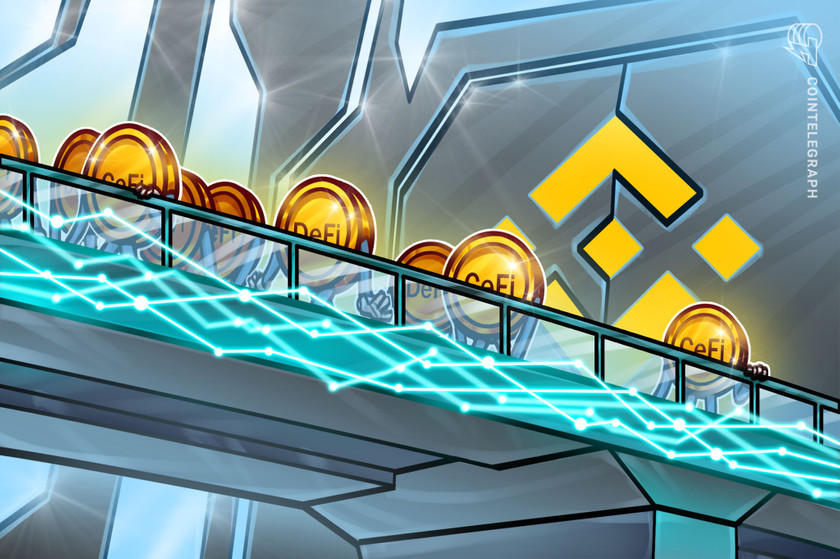

Read this guide to learn how to bridge assets from any blockchain to BNB Chain using Binance Bridge 2.0.
Integration of CeFi and DeFi through Binance Bridge 2.0
DeFi is driving the development of cutting-edge Web3 use cases such as nonfungible tokens (NFTs), gaming and the metaverse. With the Binance Bridge 2.0, DeFi can be brought to a broader audience worldwide while maintaining the same smooth user experience as CeFi.
Most of the “DeFi” ecosystem relies on centralized services because of convenience, which enables us to understand where the traditional world of centralized banking and the new world of decentralized money might intersect to everyone’s benefit.
Binance, with its first bridge, made it possible to bridge assets listed on Binance.com to other blockchains. To integrate CeFi and DeFi, the Binance Bridge 2.0 comes to the rescue by allowing you to wrap ERC20 tokens to BEP20 BTokens and start staking your Ethereum or other supported assets with DeFi protocols running on the BNB Smart Chain right away.
Binance also implemented a whole new automatic token circulation control system. Except for a buffer size in hot wallets, the exchange will not keep a surplus of pegged tokens known as wrapped assets. Instead, when users withdraw pegged tokens onto the BNB Smart Chain, it will print more tokens.
The Binance Bridge 2.0 is a trusted bridge that operates on the BNB Smart Chain with transaction fees as low as a few cents and transaction speeds as fast as three seconds. It is safeguarded by Binance’s highest security standards and operates on the BNB Smart Chain.
Nearly all Ethereum-based coins will be supported via the Binance Bridge 2.0, allowing direct access to BNB Smart Chain DApps. This cross-chain bridge improves interoperability between several blockchains and gives you direct access to the DeFi world of the BNB Smart Chain.
Related: What are DApps? A beginner’s guide to decentralized applications
How does Binance Bridge 2.0 work?
BTokens are tied to the underlying asset at a 1:1 ratio, and you can redeem your BTokens to the original asset whenever you desire.
As BTokens will be pegged at a 1:1 ratio to the underlying assets, they can be exchanged for the original cryptos. Bridged tokens that aren’t displayed on the platform will only be transferred to the funding wallet. Likewise, the platform’s bridged tokens would be moved to the funding or spot wallet. According to Binance, the most significant change is that you will be able to accomplish all of this straight from your Binance account rather than having to create a third-party wallet.
The listed tokens will go straight into your funding or spot wallet while the unlisted bridged tokens will be stored in a separate self-custody wallet (SCW) within the Binance App. A self-custody wallet lets users store digital assets such as cryptocurrencies. To transact with blockchain-based financial applications like the Compound Liquidity Pool, SCWs, also known as non-custodial wallets, are necessary.
The cross-chain bridge will promote interoperability between multiple blockchains and allow users to immediately access the Defi on the BNB Chain, as stated by the platform. This advancement is projected to raise demand for the Binance platform, eventually reflected in its higher valuation.
Why is cross-chain technology important?
A cross-chain technology aims to allow value and information to be transferred between multiple blockchain networks. It’s becoming a major issue of debate, as it’s considered the final option for improving blockchain interoperability.
People have mostly been unable to reap the full benefits of distributed ledger technology because the chains operate in isolation. As a result, people have been unable to fully benefit from blockchain technology because of the incapacity of multiple blockchains to communicate.
Cross-chain technology aims to address these concerns by providing interoperability between blockchains, allowing them to communicate and share information more easily. Ripple (XRP) is a good example of a blockchain project exploring cross-chain transactions. Ripple has already been assisting banks worldwide in settling cross-border payments in various fiat currencies and cryptocurrencies.
Other significant blockchain interoperability projects include the Polkadot (DOT) blockchain. It ensures a seamless connection between public networks, private chains, permission-less interfaces and oracles.
In addition, the developers behind the blockchain interoperability solutions want to enable an internet where independent blockchain solutions will be able to exchange information via a Polkadot relay chain.
What is Binance Bridge 2.0?
Binance Bridge 2.0 is a new bridge service that gives all popular blockchain networks access to inter-blockchain liquidity.
Binance launches Binance Bridge 2.0 to connect Ethereum-based tokens (both listed and unlisted) as BTokens to the BNB Chain. You can use your wrapped BTokens to explore the metaverse, blockchain-based games, decentralized finance (Defi) and more in the BNB Chain ecosystem, reducing the need for swaps and overcoming other interoperability barriers that have plagued blockchain.
Therefore, Binance users will be able to use the bridge as a one-stop shop for all centralized finance (Cefi) and DeFi. The intent behind the first version of the Binance Bridge was to make multiple blockchains more interoperable. In addition, it allowed anyone to exchange their crypto assets into Binance Chain (now BNB Chain) and Binance Smart Chain (now BNB Smart Chain) wrapped tokens (and vice versa).
The technique for swapping tokens (supported only on Binance.com) contains two categories in the first version: Peg-In and Peg-Out. Using Peg-In, users can swap native tokens for pegged tokens on the BNB Chain or BNB Smart Chain. Meanwhile, the Peg-Out technique allows users to convert pegged tokens to native tokens on the BNB Chain or the BNB Smart Chain.
Regular deposit and withdrawal functionalities in the Binance Bridge version 2.0 allow users to bridge tokens between their original blockchains and the BNB Chain. In the future, Binance also wants to improve its mobile app to enable users to perform similar conversions with a single click.
This article aims to discuss the integration of CeFi and DeFi through Binance Bridge 2.0 and how the Binance Bridge works.


Read this guide to learn how to bridge assets from any blockchain to BNB Chain using Binance Bridge 2.0.
Integration of CeFi and DeFi through Binance Bridge 2.0
DeFi is driving the development of cutting-edge Web3 use cases such as nonfungible tokens (NFTs), gaming and the metaverse. With the Binance Bridge 2.0, DeFi can be brought to a broader audience worldwide while maintaining the same smooth user experience as CeFi.
Most of the “DeFi” ecosystem relies on centralized services because of convenience, which enables us to understand where the traditional world of centralized banking and the new world of decentralized money might intersect to everyone’s benefit.
Binance, with its first bridge, made it possible to bridge assets listed on Binance.com to other blockchains. To integrate CeFi and DeFi, the Binance Bridge 2.0 comes to the rescue by allowing you to wrap ERC20 tokens to BEP20 BTokens and start staking your Ethereum or other supported assets with DeFi protocols running on the BNB Smart Chain right away.
Binance also implemented a whole new automatic token circulation control system. Except for a buffer size in hot wallets, the exchange will not keep a surplus of pegged tokens known as wrapped assets. Instead, when users withdraw pegged tokens onto the BNB Smart Chain, it will print more tokens.
The Binance Bridge 2.0 is a trusted bridge that operates on the BNB Smart Chain with transaction fees as low as a few cents and transaction speeds as fast as three seconds. It is safeguarded by Binance’s highest security standards and operates on the BNB Smart Chain.
Nearly all Ethereum-based coins will be supported via the Binance Bridge 2.0, allowing direct access to BNB Smart Chain DApps. This cross-chain bridge improves interoperability between several blockchains and gives you direct access to the DeFi world of the BNB Smart Chain.
Related: What are DApps? A beginner’s guide to decentralized applications
How does Binance Bridge 2.0 work?
BTokens are tied to the underlying asset at a 1:1 ratio, and you can redeem your BTokens to the original asset whenever you desire.
As BTokens will be pegged at a 1:1 ratio to the underlying assets, they can be exchanged for the original cryptos. Bridged tokens that aren’t displayed on the platform will only be transferred to the funding wallet. Likewise, the platform’s bridged tokens would be moved to the funding or spot wallet. According to Binance, the most significant change is that you will be able to accomplish all of this straight from your Binance account rather than having to create a third-party wallet.
The listed tokens will go straight into your funding or spot wallet while the unlisted bridged tokens will be stored in a separate self-custody wallet (SCW) within the Binance App. A self-custody wallet lets users store digital assets such as cryptocurrencies. To transact with blockchain-based financial applications like the Compound Liquidity Pool, SCWs, also known as non-custodial wallets, are necessary.
The cross-chain bridge will promote interoperability between multiple blockchains and allow users to immediately access the Defi on the BNB Chain, as stated by the platform. This advancement is projected to raise demand for the Binance platform, eventually reflected in its higher valuation.
Why is cross-chain technology important?
A cross-chain technology aims to allow value and information to be transferred between multiple blockchain networks. It’s becoming a major issue of debate, as it’s considered the final option for improving blockchain interoperability.
People have mostly been unable to reap the full benefits of distributed ledger technology because the chains operate in isolation. As a result, people have been unable to fully benefit from blockchain technology because of the incapacity of multiple blockchains to communicate.
Cross-chain technology aims to address these concerns by providing interoperability between blockchains, allowing them to communicate and share information more easily. Ripple (XRP) is a good example of a blockchain project exploring cross-chain transactions. Ripple has already been assisting banks worldwide in settling cross-border payments in various fiat currencies and cryptocurrencies.
Other significant blockchain interoperability projects include the Polkadot (DOT) blockchain. It ensures a seamless connection between public networks, private chains, permission-less interfaces and oracles.
In addition, the developers behind the blockchain interoperability solutions want to enable an internet where independent blockchain solutions will be able to exchange information via a Polkadot relay chain.
What is Binance Bridge 2.0?
Binance Bridge 2.0 is a new bridge service that gives all popular blockchain networks access to inter-blockchain liquidity.
Binance launches Binance Bridge 2.0 to connect Ethereum-based tokens (both listed and unlisted) as BTokens to the BNB Chain. You can use your wrapped BTokens to explore the metaverse, blockchain-based games, decentralized finance (Defi) and more in the BNB Chain ecosystem, reducing the need for swaps and overcoming other interoperability barriers that have plagued blockchain.
Therefore, Binance users will be able to use the bridge as a one-stop shop for all centralized finance (Cefi) and DeFi. The intent behind the first version of the Binance Bridge was to make multiple blockchains more interoperable. In addition, it allowed anyone to exchange their crypto assets into Binance Chain (now BNB Chain) and Binance Smart Chain (now BNB Smart Chain) wrapped tokens (and vice versa).
The technique for swapping tokens (supported only on Binance.com) contains two categories in the first version: Peg-In and Peg-Out. Using Peg-In, users can swap native tokens for pegged tokens on the BNB Chain or BNB Smart Chain. Meanwhile, the Peg-Out technique allows users to convert pegged tokens to native tokens on the BNB Chain or the BNB Smart Chain.
Regular deposit and withdrawal functionalities in the Binance Bridge version 2.0 allow users to bridge tokens between their original blockchains and the BNB Chain. In the future, Binance also wants to improve its mobile app to enable users to perform similar conversions with a single click.
This article aims to discuss the integration of CeFi and DeFi through Binance Bridge 2.0 and how the Binance Bridge works.